
I
Ambika Kalna is a town whose history begins with a river, but whose identity was ultimately shaped by a goddess. Situated on the western bank of the Bhagirathi, Kalna occupies a narrow stretch of high land along one of the major channels of the Ganges system. Its geographical position was fundamental to its historical development: the river connected the settlement to the wider networks of movement, pilgrimage and commerce that bound Bengal together.
Today, Kalna is popularly known as Ambika Kalna, a name associated with Goddess Ambika, worshipped here as Siddheshwari. The association between the town and the goddess is so deeply embedded in its historical memory that Ambika became not merely the presiding deity of a shrine, but part of the very identity of the settlement. The Siddheshwari temple therefore provides an important starting point for understanding Kalna—not simply as a place where temples were later constructed, but as a landscape in which sacred geography had long been central to the character of the town.
The antiquity of Kalna, however, needs to be approached carefully. Local traditions and later antiquarian accounts have attempted to push its history deep into the early medieval period. Alexander Cunningham, for instance, identified Kalna with a frontier settlement associated with the ancient political geography of Tamralipta and connected it with the reign of Shashanka. These interpretations are important as part of the history of how Kalna's past has been imagined, but they should not automatically be treated as conclusive proof for the continuous existence of the present town in precisely the same form. What can be said with greater confidence is that Kalna's historical landscape possesses medieval depth, and that by the early modern period it had already become a significant settlement on the Bhagirathi.
Kalna's importance also lay in its position between sacred and economic worlds. The Bhagirathi was not merely a geographical boundary; it was an artery through which people, goods and ideas moved. Kalna consequently developed within the wider riverine economy of Bengal, while its religious institutions attracted pilgrims and patrons. This combination of river, market and shrine would become fundamental to the town's later prosperity. The nineteenth-century statistical accounts of Bengal still preserve evidence of Kalna's commercial significance, demonstrating that its riverine connections remained important even after the great age of its temple-building had begun to pass.
The religious character of Kalna was never confined to a single tradition. Shakta worship centred on Ambika/Siddheshwari, Vaishnavism associated with the Chaitanya tradition, Shaiva worship and Islam all left their marks upon the town. A mosque constructed in 1533 during the Bengal Sultanate period is an important reminder that medieval Kalna existed within a plural political and religious world. Thus, the history of Ambika Kalna is not the history of one uninterrupted religious tradition; it is the history of a settlement in which different communities, devotional traditions and political formations occupied the same riverine landscape.
It was only later, particularly during the eighteenth century, that Kalna acquired the monumental form for which it is famous today. The rise of the Bardhaman Raj transformed the town's religious landscape through sustained architectural patronage. Raja Chitra Sen received the title of Raja from the Mughal emperor in 1740 and is associated with the construction of the Siddheshwari Temple. Under his successor Tilak Chand and later members of the Bardhaman family, numerous temples were constructed in Kalna.
The result was extraordinary.
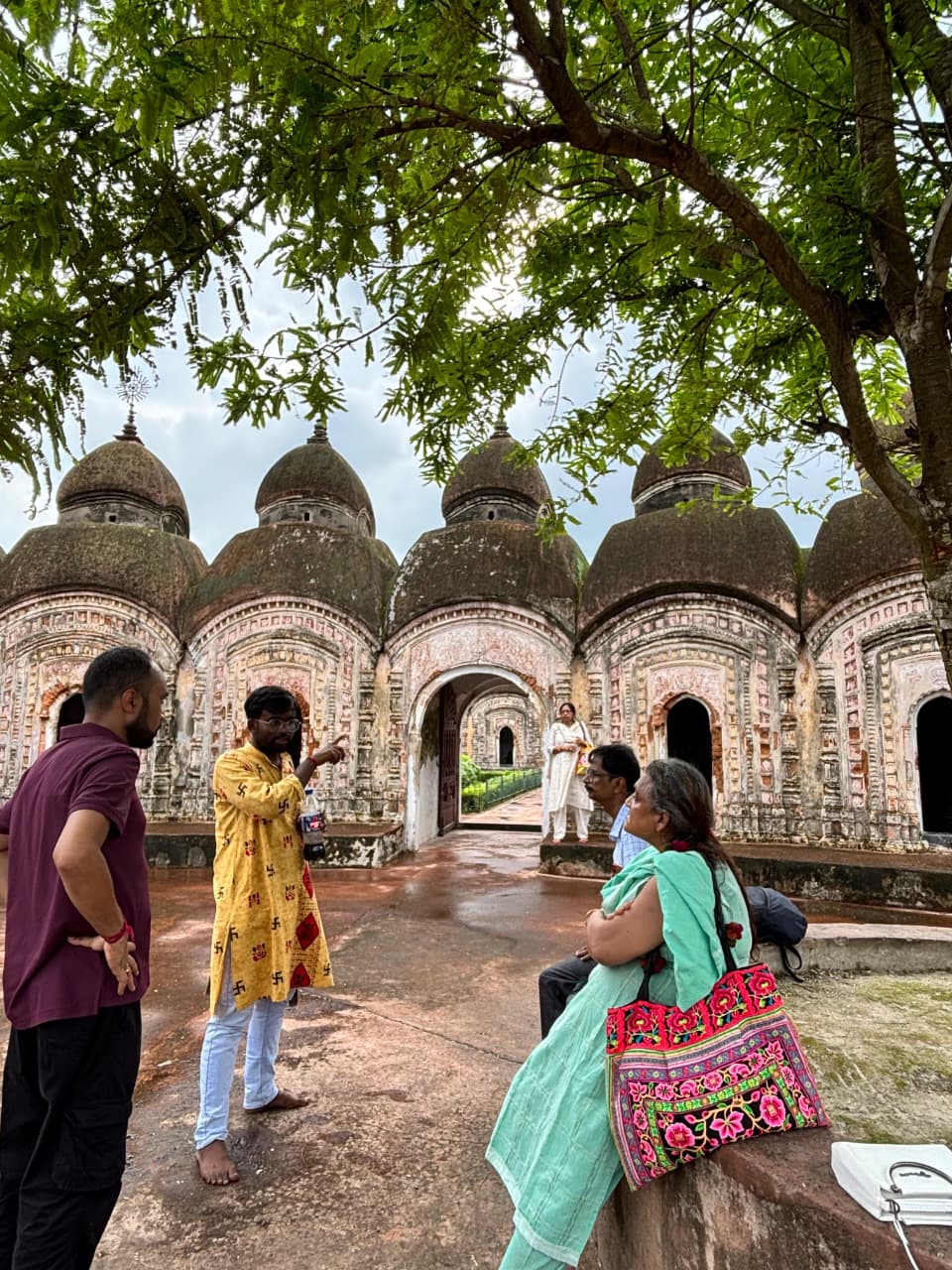
Kalna became a concentrated landscape of Bengal's architectural imagination: curved chala roofs, ratna temples, deul forms, brick construction and elaborate terracotta sculpture came together within a relatively small urban space. The Rajbari complex represents the most spectacular expression of this transformation. As S. S. Biswas observes, Kalna contains examples of almost all the major temple forms found in Bengal, while the temples of the Rajbari complex preserve extensive terracotta ornamentation and dedicatory inscriptions identifying their patrons and dates.
Therefore, when we enter Ambika Kalna, we should not begin by asking simply, “Who built these temples?” We should ask a larger question: What kind of town had to exist before such a landscape could be created?
The answer takes us from the Bhagirathi to the marketplace, from the goddess to the pilgrim, from the agrarian countryside to the zamindar's court, and finally from wealth and devotion to brick and terracotta. That is the story of Ambika Kalna.
II
If the introduction to Kalna begins with Ambika, the next question must be: what kind of society produced a town in which so many religious and architectural traditions could flourish together?
The answer begins with geography. Kalna stands on the western bank of the Bhagirathi, on a narrow strip of relatively high ground beside one of Bengal's principal river channels. S. S. Biswas, in his study of the temples of Kalna, describes the town as stretching along the Bhagirathi and emphasises that its historical development can be traced to the medieval period. The river was not simply scenery. In pre-modern Bengal, waterways were among the most important systems of communication, linking agricultural hinterlands with market towns, administrative centres and larger commercial networks.
This is crucial for understanding why Kalna became important at all.
The Bhagirathi connected Kalna southwards towards the Hooghly and ultimately the maritime world of Bengal, while northward river routes connected it with the interior. Goods could travel by boat far more efficiently than by land through a landscape of rivers, marshes and seasonal flooding. Kalna therefore developed as a point where the agrarian economy of the countryside met the riverine economy of Bengal.
And Bengal was, by the seventeenth and eighteenth centuries, one of the most commercially dynamic regions of the Mughal Empire. Older colonial histories often described the eighteenth century as an age of inevitable decline following the weakening of Mughal authority. John R. McLane has shown why this picture is inadequate. The late Mughal economy was already experiencing increasing monetisation, commercialisation, commodity production and long-distance trade. Silver entering India from Europe was converted into rupees, while growing markets encouraged peasants, merchants and entrepreneurs to produce increasingly for exchange rather than solely for subsistence. Bengal was one of the most important beneficiaries of these processes.
The prosperity of Bengal rested fundamentally upon its agriculture. Its extraordinarily fertile alluvial environment supported intensive cultivation, particularly of rice, while other crops and specialised commodities entered regional and international markets. Agricultural surplus could be converted into revenue, and revenue could then circulate through markets, merchants, financiers, officials and religious institutions. This is where Kalna's location becomes significant.
The town was surrounded by an agrarian hinterland capable of feeding urban and commercial populations, while the Bhagirathi provided the means of moving that surplus. The nineteenth-century Statistical Account of Bengal still records the importance of rice, cotton, oilseeds, vegetables and other agricultural products in the wider Bardhaman region, as well as the importance of river communication. By then, of course, the economy had already undergone substantial transformation, but these records provide a valuable glimpse of the economic ecology in which Kalna existed.
It is easy, when walking through Kalna today, to imagine that its historical population consisted primarily of priests and pilgrims. It did not. Behind every temple existed a much larger society.
Cultivators were producing the agricultural surplus; boatmen carrying commodities along the Bhagirathi; merchants arranging exchange; moneylenders and bankers providing credit; artisans producing textiles, metalwork, pottery and architectural decoration; masons and terracotta craftsmen constructing temples; scribes and revenue officials managing accounts; Brahmins and other religious specialists serving temples; and labourers supporting the everyday functioning of the town. This social world was deeply interconnected with the zamindari system.
The Mughal state did not normally administer every village directly. Revenue was collected through layers of intermediaries, including zamindars and other local authorities. The large zamindars were simultaneously agents of the state and local power-holders. They collected revenue from agricultural society, maintained networks of dependants and retainers, and exercised considerable influence over local institutions. McLane's study of eighteenth-century Bengal emphasises this dual character precisely: zamindars extracted revenue for the state while also cultivating relationships of patronage, gift-giving and political authority within their territories. This is particularly important in understanding the rise of the Bardhaman Raj.
The family did not suddenly appear as an independent Hindu kingdom. Its rise occurred inside the Mughal political and revenue system. According to McLane, the family's productive partnership with the Mughal administration was established by 1657, when Abu Rai was appointed kotwal of Burdwan. By 1680 the family had acquired a zamindari and entered the Mughal revenue-collecting hierarchy. Over subsequent decades, its holdings expanded enormously; by the middle of the eighteenth century the Burdwan zamindari covered approximately 5,000 square miles and hundreds of villages. This transformation tells us something important about Bengal itself.
As Mughal authority became increasingly localised in the late seventeenth and early eighteenth centuries, large hereditary zamindars became more powerful. McLane describes how Murshid Quli Khan's revenue reforms concentrated collection in fewer, larger zamindaris, while the weakening of Delhi's authority allowed local landed elites to acquire greater autonomy. In other words, the decline of the Mughal Empire did not immediately mean the collapse of Bengal's economy. In many places it meant a reorganisation of power.
The old imperial structure was changing, but commerce, agriculture and revenue extraction continued. Indeed, Bengal's prosperity attracted European trading companies. The Dutch, English and French were increasingly involved in the region's commercial networks. European factories depended upon Bengali merchants, brokers and gomashtas to obtain textiles and other commodities. McLane notes that by the early eighteenth century Bengali merchants were contracting to supply local merchandise to European factories, while western Indian bankers became deeply involved in the collection and transmission of land revenue. This is the Bengal in which Kalna existed. It was not an isolated temple town. It belonged to a commercially connected province.
Kalna's riverine position meant that its economic life was closely connected to movement. The later nineteenth-century accounts describe Kalna as a river-based commercial centre, while the Imperial Gazetteer records that the importance of Kalna and Katwa declined after the opening of the East Indian Railway because railway traffic increasingly replaced older river routes. This later decline is revealing precisely because it shows how important the older river system had been. Before the railway, the river was infrastructure.
A boat arriving at a ghat could bring grain, textiles, salt or other commodities; merchants could purchase and redistribute them; agricultural producers could sell surplus; religious establishments could receive donations and supplies. The ghat was consequently both a physical landing place and a point where different social worlds encountered one another. This also helps explain why religious centres and commercial centres so often existed together in Bengal.
Pilgrims needed food, accommodation, transport and markets. Festivals created temporary concentrations of people and consumption. Temples required priests, musicians, cooks, craftsmen and suppliers. Religious patronage therefore generated economic activity, while commercial wealth could in turn finance religious institutions.
Why Ambika?
It is in this setting that we can better understand the name Ambika Kalna. The town's identity became deeply associated with the goddess Ambika, worshipped at the Siddheshwari shrine. The local historical tradition identifies the goddess as the source of the name “Ambika Kalna.” But the significance of Ambika goes beyond etymology.
In Bengal, sacred geography was often produced through the relationship between deity, shrine, settlement and community. A goddess could become the symbolic centre of a locality, while the settlement surrounding her shrine acquired its own ritual identity.
Kalna consequently developed as a layered sacred landscape rather than a single-purpose pilgrimage centre. Shakta traditions associated with Ambika/Siddheshwari existed alongside Shaiva worship and Vaishnava traditions. The association of Kalna with the Chaitanya movement added another dimension to its religious importance. At the same time, Islamic institutions were part of the town's historical landscape. A mosque at Kalna bears an inscription dating its construction to 1533, during the Bengal Sultanate. Another archaeological record identifies a mosque inscription from Kalna dating to 1512–13.
This evidence matters because it prevents us from imagining Kalna as a purely Hindu sacred town existing outside the political history of Muslim Bengal. Kalna was part of Sultanate Bengal, Mughal Bengal and later Nawabi Bengal. Its society was correspondingly diverse.
The eighteenth century brought another transformation. The expanding power of the Bardhaman Raj meant that agricultural revenue could be transformed into political patronage and monumental culture. McLane stresses that zamindars did not merely collect revenue; they also maintained forms of kingship through gifts, religious patronage and public display.
This is the key to understanding the extraordinary temple landscape of Kalna. The temples were not simply expressions of private faith. They were also public statements of power. When the Bardhaman rulers constructed temples, they were investing wealth derived from a large agrarian estate into religious and architectural institutions. Through temples, festivals, images and ritual patronage, the zamindar could present himself not merely as a revenue collector but as a protector of religion and a legitimate local ruler.
The architectural landscape therefore converted economic power into cultural authority. This process can be seen dramatically in the Rajbari complex. The Lalji Temple, Krishna Chandra Temple, Pratapesvara Temple, Rasmancha and the other structures represent different stages and forms of Bengal's temple architecture. David McCutchion's classification of Bengal's late-medieval temples demonstrates the extraordinary variety of architectural forms developed in the region—chala, ratna, deul, dalan and related forms—while Kalna preserves several of these traditions within a remarkably concentrated landscape. The terracotta is equally significant.
These temples were constructed in brick, and their surfaces became vast visual fields. Epic and Puranic narratives coexist with floral decoration, animals, musicians, warriors, courtly scenes and representations of contemporary life. The walls therefore preserve something that written political histories often overlook: the visual culture of society itself.
And this is perhaps the most beautiful paradox of Kalna. The wealth that produced these temples came from a society of cultivators, merchants, financiers and artisans. Yet the people who generated that wealth often disappear from the names written on the monuments. What survives instead is their world, indirectly represented in terracotta. A changing Bengal, but the story did not end with prosperity.
The eighteenth century also brought enormous instability. The Maratha invasions of 1742–51 devastated large parts of western Bengal. McLane notes that Burdwan, Bishnupur, Birbhum and Midnapore suffered particularly heavily. Although the Burdwan Raj survived, the invasions created severe hardship and contributed to an economic crisis in the region.
Then came the catastrophic famine of 1770, which exposed the vulnerability of Bengal's agrarian economy. And eventually came the East India Company's consolidation of political power. The Permanent Settlement of 1793 fundamentally altered the relationship between zamindars, state and cultivators. The zamindar increasingly became a revenue-paying landholder under a new colonial legal framework. The older language of Mughal service, political favour and personalised patronage gradually gave way to a more rigid system of property and revenue.
Kalna's riverine economy also eventually suffered from technological change. The expansion of railways in the nineteenth century redirected commercial traffic away from older river ports. The Imperial Gazetteer explicitly records the declining importance of Kalna and Katwa after railway expansion. Thus, the Kalna we see today is the product of several different economic worlds.
First came the river. Then the agrarian-commercial expansion of Mughal Bengal. Then the increasing power of zamindars and merchants. Then the extraordinary patronage of the Bardhaman Raj. Then colonial restructuring, railway expansion and the decline of the older riverine commercial order. The temples remained. The economy around them changed. And that is why Ambika Kalna is so important historically.
It allows us to see, within one town, the relationship between land and river, peasant and zamindar, merchant and market, pilgrim and temple, Mughal authority and local power, prosperity and crisis. The Rajbari complex is therefore not merely an architectural collection. It is the stone-and-brick memory of a changing Bengal.
III
To understand Ambika Kalna finally, we must resist the temptation to see it only as the “Temple City.” That description is true, but incomplete. The temples are perhaps the most visible part of Kalna's history; they are not its entire history.
Kalna was first and foremost a riverine settlement. Its position beside the Bhagirathi placed it within the movement of people, commodities and ideas that connected the interior of Bengal with its larger commercial world. The town's prosperity emerged from the relationship between the river and its agrarian hinterland, between the producer and the market, and between local commerce and the wider economy of Bengal.
That economic world produced a complex society. Cultivators, merchants, boatmen, artisans, financiers, religious specialists, administrators and landed elites all participated in it. The wealth that eventually appeared in the form of magnificent temples did not descend upon Kalna from nowhere. It was generated through the agrarian and commercial structures of Bengal, accumulated by powerful landed families, and then redistributed through patronage.
The rise of the Bardhaman Raj represents one of the most important transformations in this story. The family itself emerged through the Mughal administrative and revenue system, and its increasing control over land and revenue allowed it to become one of the most powerful zamindari houses of eighteenth-century Bengal. The political language of the family gradually changed as well. The zamindar was not simply a revenue intermediary; through religious patronage, gifts, ritual and architecture, he could represent himself as a local ruler and protector of society.
Kalna became one of the greatest stages upon which this new form of local kingship was performed. The temples of the Rajbari complex therefore need to be read simultaneously as religious institutions, works of art and political statements. Lalji, Krishna Chandra, Pratapesvara and the other temples were not merely constructed because their patrons were devout. They were part of a broader culture of patronage through which wealth, authority and religious legitimacy were made visible. S. S. Biswas's study is particularly important here: Kalna became one of the most concentrated repositories of Bengal's temple forms, with the Rajbari complex preserving monumental ratna temples alongside chala and deul traditions. And then there is the terracotta.
Perhaps the greatest gift of Kalna's temples to the historian is that their walls allow us to look beyond the rulers who commissioned them. The terracotta panels depict gods and goddesses, as well as animals, musicians, warriors, processions, hunting scenes, ships, floral motifs, and representations of everyday life. They provide fragments of a social world that formal political records rarely describe. The walls of the temples therefore become an archive—not an archive written by scribes, but one created by artisans.
The artisans themselves are largely anonymous. And that anonymity is significant.
The Rajbari complex carries the names of kings, queens and patrons, but its beauty was produced by hundreds of craftsmen whose individual names have largely disappeared. The monumental landscape therefore reminds us of a fundamental truth about history: power may commission monuments, but society makes them possible.
Kalna also refuses a simple religious narrative. Its identity as Ambika Kalna derives from the enduring association with Ambika/Siddheshwari, yet the town developed through multiple religious traditions. Shakta, Shaiva and Vaishnava practices existed alongside the Islamic presence documented in the medieval town. Kalna's sacred geography was consequently cumulative rather than exclusive. One tradition did not necessarily erase another; instead, successive communities and patrons added new layers to an already ancient landscape. This is perhaps why the name Ambika Kalna matters so much.
“Ambika” does not merely tell us the name of a goddess. It tells us how a community remembered its town. A settlement beside a river became a sacred place; a sacred place became a centre of pilgrimage and commerce; a commercially connected settlement became attractive to powerful landed patrons; those patrons transformed their wealth into monumental architecture; and those monuments eventually became the historical identity through which later generations remembered the town. But history did not stop with the eighteenth-century flowering.
The prosperity of the old riverine world was eventually disrupted by war, famine, colonial restructuring and technological change. The Maratha invasions devastated large parts of western Bengal in the 1740s and early 1750s. The famine of 1770 exposed the profound vulnerability of Bengal's agrarian society. The Permanent Settlement subsequently altered the relationship between zamindars, the colonial state and cultivators. And the coming of the railway gradually displaced the older river-based commercial networks on which places like Kalna had depended.
The irony is striking. The economic world that created Kalna's monumental landscape disappeared, but the monuments survived.
The river still flows beside the town, but its historical function has changed. The old commercial networks have largely vanished. The Bardhaman Raj no longer exercises the political power that once enabled its architectural patronage. Yet the temples remain—quietly carrying within their bricks and terracotta the memory of a society that no longer exists in the same form. That is why walking through Kalna is different from simply visiting a temple.
When we stand before the Rajbari complex, we are standing at the intersection of river and land, peasant and zamindar, merchant and market, devotion and politics, Mughal authority and regional power, prosperity and crisis.
The Rajbari is therefore not simply a collection of beautiful buildings. It is the material biography of a changing Bengal. And Ambika Kalna is not merely a “Temple City.” It is a town where the history of Bengal can be read in layers—in the river that carried its commerce, in the soil that produced its wealth, in the goddess who gave it sacred identity, in the zamindars who transformed wealth into patronage, and in the anonymous artisans who transformed patronage into art. Perhaps that is the most appropriate way to enter the Rajbari complex: not as tourists entering a collection of monuments, but as historians entering an archive.
An archive made not of paper—but of brick, river, memory and terracotta.