
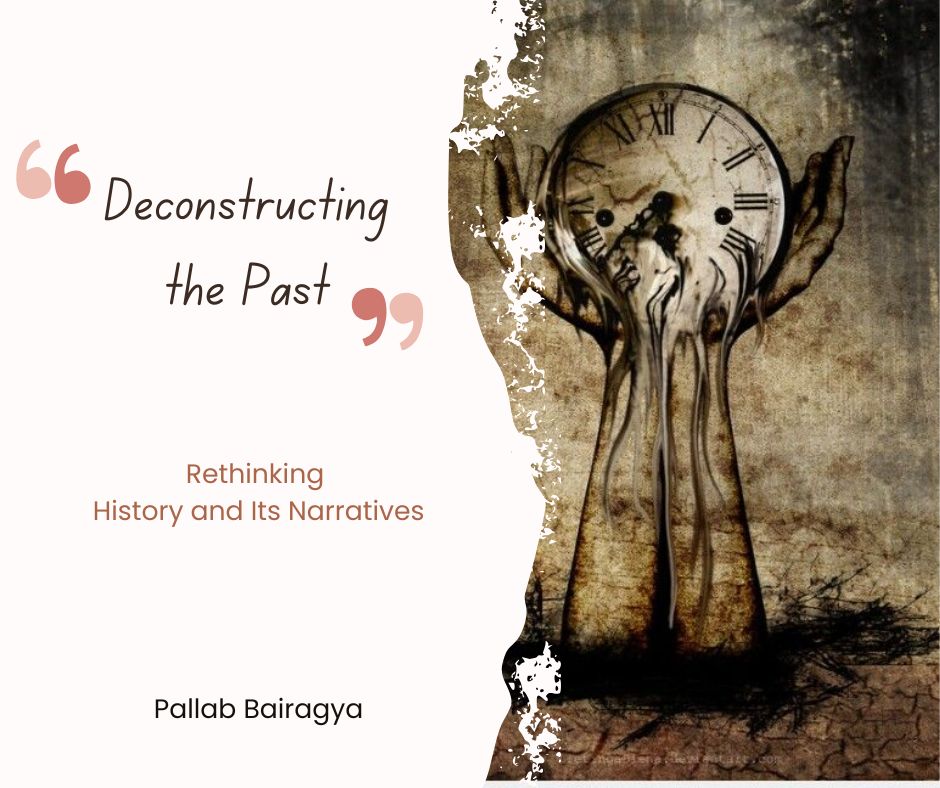
Deconstruction and postcolonialism have significantly influenced the ways in which historians engage with the past, particularly in relation to the writing of history and the interrogation of historical narratives. Deconstruction, as introduced by Jacques Derrida, questions the very foundation of meaning, arguing that language and texts do not possess fixed meanings but instead generate endless chains of signification. When applied to history, deconstruction reveals that historical narratives are not neutral or objective accounts of the past but are constructed within ideological frameworks, shaped by the biases and power structures of those who produce them. Postcolonialism, on the other hand, builds upon this critique by emphasizing the role of colonialism in shaping historical knowledge, highlighting the erasure of subaltern voices, and contesting Eurocentric interpretations of non-European pasts.
One of the most crucial implications of deconstruction in historical studies is its challenge to the idea of a singular, authoritative history. Traditionally, history has been written with an assumption of linearity and factual accuracy, often privileging written records over oral traditions and other alternative sources of knowledge. Derrida’s concept of différance, which suggests that meaning is always deferred and never fully present, applies to historical narratives as well, indicating that no historical account is ever complete or final. This is particularly evident in the historiography of medieval India, where the dominant narratives have often been constructed within colonial, nationalist, or religious frameworks, each interpreting the past in ways that serve their respective ideological agendas.
A striking example can be found in the colonial historiography of medieval India, particularly in British narratives that framed the period as an era of "Muslim despotism" preceding the "civilized" British rule. Historians such as James Mill, in his History of British India (1817), divided Indian history into Hindu, Muslim, and British periods, reinforcing a binary that has had lasting implications for communal historiography. This categorization imposed a rigid and teleological structure on Indian history, portraying Muslim rulers as tyrannical oppressors and Hindu subjects as passive victims awaiting salvation through British governance. Deconstruction allows historians to challenge such imposed binaries, revealing the underlying biases and inconsistencies within these colonial constructions. A deconstructive reading of Mughal rule, for instance, would expose how figures like Akbar, often categorized as a benevolent exception among so-called despotic rulers, are framed within narratives that ignore the complexities of governance, administrative structures, and cultural synthesis.
Postcolonialism further deepens this critique by analyzing how colonial narratives erased indigenous perspectives and subaltern voices. Edward Said’s Orientalism (1978) demonstrated how European scholars constructed an image of the East as an exotic, backward, and irrational "Other," which justified colonial domination. This framework was evident in the writings of colonial historians like Vincent Smith, whose portrayal of medieval India emphasized religious conflicts and dynastic rivalries while downplaying economic structures, social mobility, and indigenous agency. The postcolonial intervention in historical studies, especially through the works of the Subaltern Studies collective, has sought to recover these marginalized voices by challenging elite-centered historiography. Ranajit Guha and his colleagues argued that colonial and nationalist histories alike tended to focus on rulers, elite political figures, and state institutions, neglecting the agency of peasants, artisans, and tribal communities in shaping historical events.
A crucial example of postcolonial historiography in medieval Indian studies is the re-examination of peasant uprisings and tribal resistance, which were often dismissed in colonial accounts as mere "disturbances" rather than legitimate political actions. The study of the Santhal Rebellion (1855-56) or the Kol Revolt (1831-32) through a postcolonial lens challenges the colonial categorization of these events as sporadic outbursts, instead interpreting them as complex struggles against economic exploitation and dispossession. Similarly, postcolonial historians have problematized the representation of the Bhakti and Sufi movements, which colonial historiography often reduced to either purely religious phenomena or as evidence of syncretism. In reality, these movements were also deeply entangled with caste, class, and gender dynamics, resisting Brahmanical hegemony and creating alternative spaces for marginalized groups.
Gayatri Spivak’s famous essay Can the Subaltern Speak? (1988) further complicates the question of historical representation by arguing that even attempts to recover subaltern voices are often mediated by elite frameworks, making it difficult for the subaltern to truly "speak" within dominant historiographical traditions. This is particularly relevant when examining the position of women in medieval Indian history. Traditional historiography has often depicted women either as passive victims of patriarchal structures or as exceptional figures such as queens and courtesans, without accounting for the ways in which everyday women negotiated power and resistance. A postcolonial and deconstructive approach would question the very sources through which medieval women’s histories are constructed, recognizing that courtly chronicles, religious texts, and legal documents often reflect the perspectives of elite men rather than the lived experiences of ordinary women. The historiography of the Mughal harem is a particularly fertile ground for such an analysis. Colonial and nationalist narratives alike have tended to exoticize the harem as a site of decadence and sensuality, reducing the women within it to objects of desire rather than active participants in court politics. Recent scholarship, however, influenced by feminist and postcolonial methodologies, has attempted to reconstruct the agency of women in the Mughal court, emphasizing their roles as political advisors, patrons of art, and key figures in succession disputes. Ruby Lal’s work on Mughal women, for instance, deconstructs the colonial portrayal of the harem by examining it as a complex socio-political institution rather than a space of passive seclusion.
Homi Bhabha’s concept of "hybridity" further complicates historical narratives by highlighting the cultural and linguistic exchanges that occurred under colonial and pre-colonial rule. Medieval India, particularly under the Delhi Sultanate and the Mughal Empire, witnessed the blending of Persianate, Indic, and Turkic traditions, resulting in new political and cultural formations. A rigid nationalist historiography, whether Hindu or Muslim, often ignores these hybridities in favor of constructing a homogenous past. Bhabha’s notion of the "third space" suggests that cultural identities are not fixed but are constantly negotiated and redefined. This perspective challenges the communal historiographies that attempt to essentialize religious identities in medieval India, instead revealing how syncretic traditions like Indo-Persian literature, Sufi-Bhakti interactions, and architectural innovations emerged from cross-cultural exchanges.
Deconstruction and postcolonialism together encourage historians to move beyond simplistic dichotomies and to recognize history as a contested field of knowledge production. The challenge lies not only in rewriting history but also in critically examining the frameworks through which history itself is written. Whether it is the colonial portrayal of medieval India as a period of stagnation, the nationalist attempts to reclaim a glorious past, or the subaltern struggles against historical erasure, these theoretical approaches remind us that history is not a fixed narrative but an ongoing process of negotiation, reinterpretation, and resistance. The role of the historian, therefore, is not just to uncover the past but to interrogate the very structures that determine how the past is remembered and represented.