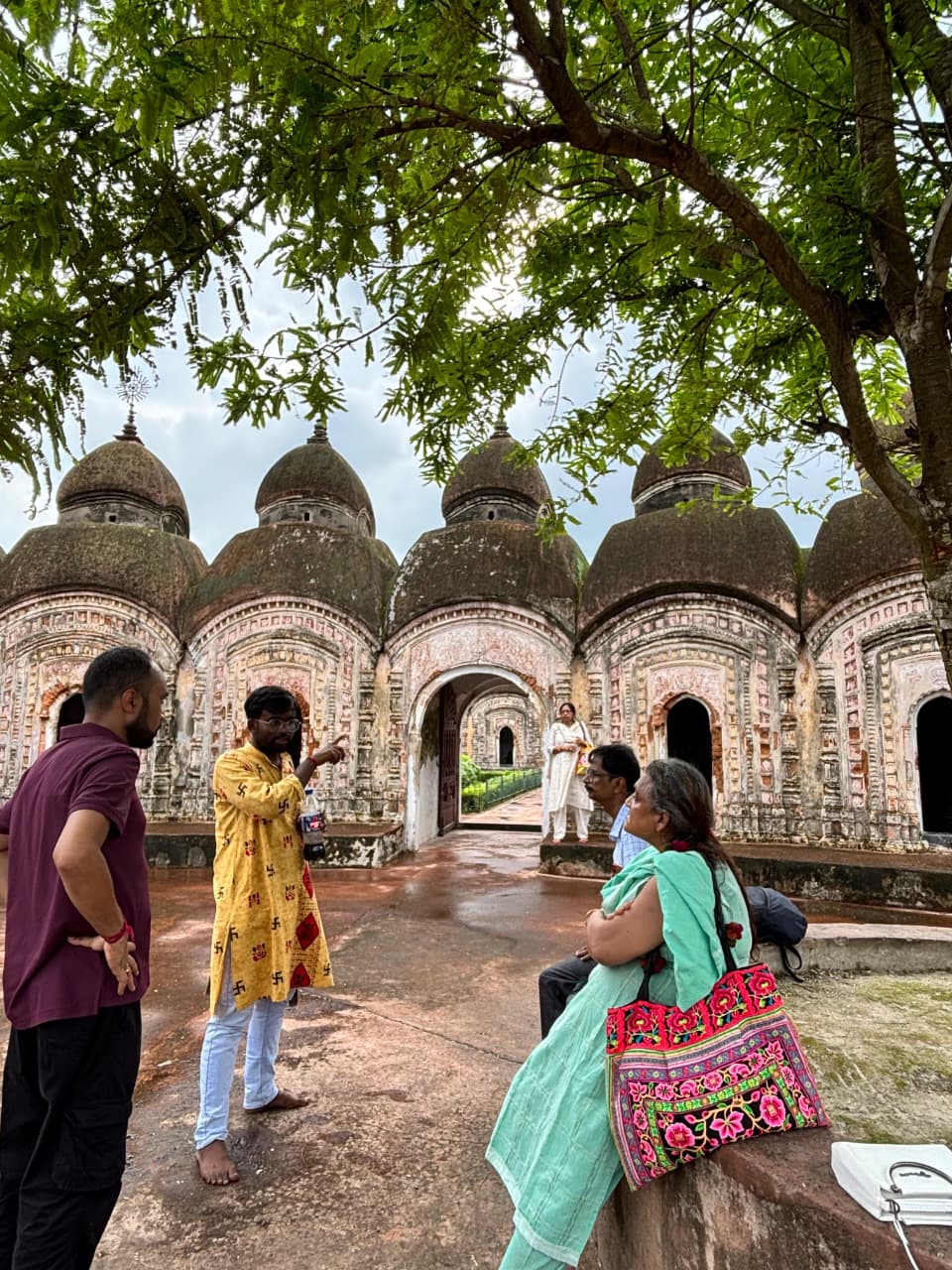

Every city possesses a story of origin. Chandannagar, however, possesses several. The very name of the town remains a subject of debate among historians, antiquarians, and residents, and perhaps it is precisely this multiplicity of memories that makes Chandannagar so unique. Unlike many colonial settlements whose histories begin with European arrival, Chandannagar's name carries echoes of a much older landscape—one shaped by rivers, merchants, deities, and myths.
One of the most widely accepted explanations derives the name from the peculiar geography of the Bhagirathi. At Chandannagar, the river takes a graceful crescent-shaped bend. When viewed from above, the course of the river resembles the shape of a half-moon or chandra. Several scholars have therefore argued that the settlement came to be known as Chandranagar—the "city of the moon"—which in popular usage gradually evolved into Chandannagar. Even today, standing on the Strand and looking at the sweeping curve of the river, one can understand why this interpretation continues to enjoy considerable popularity.
A second and equally compelling theory associates the name with the worship of the goddess Chandi. Long before the establishment of the French settlement in 1673, this region appears to have been an important centre of Shakta worship. Local traditions maintain that an ancient shrine dedicated to the goddess Chandi once existed in the locality and that the settlement derived its name from this deity. The historian Harihar Seth, one of the earliest chroniclers of Chandannagar, attached considerable importance to this tradition. According to him, the sacred geography of the region and the prevalence of goddess worship strongly suggest that the origins of the settlement may have been intimately connected with the cult of Chandi. In this interpretation, Chandannagar was originally Chandinagar or the abode of the goddess Chandi, which over time transformed linguistically into Chandannagar.
A third explanation links the town with the legendary merchant Chand Sadagar, the immortal protagonist of the medieval Manasamangal literature. In Bengali cultural memory, Chand Sadagar symbolises maritime commerce, long-distance trade, and the riverine world of precolonial Bengal. According to local tradition, Chand Sadagar is believed to have traversed this stretch of the Bhagirathi during his commercial voyages. Some even suggest that he established a trading station in this region, leading to the area being known as Chand's Nagar or Chandannagar. It reveals how deeply the inhabitants of Chandannagar associate their town with Bengal's ancient mercantile past and with the riverine trading networks that once connected Bengal to distant parts of the Indian Ocean world.
A fourth interpretation, preserved in local memory and discussed by several local historians, associates the name with chandan or sandalwood. According to this theory, the region may once have been associated either with the trade of sandalwood or with the presence of sandalwood trees in the locality. While historical evidence in support of this argument remains limited, it nevertheless reflects the commercial character of the region and its long association with trade and exchange.
The earliest documentary references to the locality, however, complicate the matter further. Before the advent of the French, the area that would later become Chandannagar consisted not of a single urban settlement but of several villages, notably Boro, Khalisani, and Gondalpara. These settlements formed part of a larger riverine landscape situated within the prosperous Hooghly region. The French did not create Chandannagar ex nihilo; rather, they consolidated and transformed an already inhabited and economically vibrant zone.
Indeed, the absence of Chandannagar as a distinct urban entity in medieval Bengali literary texts such as the Chandimangal and Manasamangal suggests that the town, as we know it today, emerged relatively late. Yet this does not imply that the region lacked historical significance. On the contrary, the various traditions surrounding the origin of the town's name reveal a much deeper historical consciousness. Whether associated with the moon-shaped river, the goddess Chandi, the legendary merchant Chand Sadagar, or the commerce in sandalwood, each explanation points towards a different aspect of the town's identity—its geography, religiosity, mercantile heritage, and collective memory.
Perhaps, therefore, the question is not which theory is correct. The true significance lies in the fact that all these traditions continue to coexist. Chandannagar has always been a meeting place: of river and land, of myth and history, of commerce and devotion, of local memory and global connections. Its very name embodies this layered past.
While the origins of the name Chandannagar remain shrouded in myth, memory, and competing traditions, the year 1696 may reasonably be regarded as the town's documentary birth year. This date acquires particular significance because it marks the earliest known written reference to the name "Chandannagar." In that year, as the French sought to consolidate their presence in Bengal—much like their English and Dutch counterparts—they undertook the construction of the famed Fort d'Orléans. During this period, Monsieur Martin, Monsieur André-François Boureau-Deslandes, and Monsieur Pellé, the French officials entrusted with the administration of the settlement, addressed a letter to François Caron, Director of the French East India Company. Significantly, beneath their signatures appeared, for the first time in recorded history, the name of the place itself: TCHANDERNAGORE. Although rendered in French orthography, this reference constitutes the earliest known documentary mention of Chandannagar. Thus, if one were to assign a formal birth year to the town, 1696 stands out as a particularly compelling candidate, for it was through the pens of these French administrators that "Chandannagar" first entered the historical archive and began its documented existence.
II
Long before Chandannagar emerged as a French colony, the region formed part of an ancient and vibrant riverine civilization whose history stretched back centuries. During the Mughal period, this tract was not known as Chandannagar at all. Instead, the landscape consisted of a constellation of old settlements such as Bilkuli, Nabagram, Khalisani, Garji, Byajra, Madhabpur, Altara, and several other villages scattered along the banks of the Bhagirathi and the now-vanished Saraswati River. These villages, though seemingly modest, were deeply integrated into the political, economic, and religious life of precolonial Bengal.
Among these settlements, Khalisani occupied a particularly significant position. The Buddhist traveller Kabiram, in his Digvijaya Prakash, referred to the locality as "Khalisani Mahagram, Jatra Raja cha Dhibara"—"Khalisani is a great village where the Dhibar kings reside." This fascinating reference suggests that before the rise of centralized states in the region, a community of Dhibars, traditionally associated with fishing and riverine occupations, exercised considerable authority over this area. The Dhibars not only controlled fishing activities but also presided over a cluster of densely populated settlements whose inhabitants derived their livelihood primarily from the river.
The history of these villages becomes clearer from the fifteenth and sixteenth centuries through various Bengali Mangal-kavya traditions. It has often been suggested that with the gradual expansion of Pathan power in Bengal, the influence of the Dhibar chiefs declined. Yet even before the arrival of the Pathans, this entire region had formed the western frontier of the prosperous domains of the Sena dynasty. During the second half of the twelfth century, a vast territory along the banks of the Saraswati River came under Sena rule. The nearby settlement of Dingal Hat (modern day Laxmi Ganj Bazar) emerged as one of the principal centres of economic activity associated with the great port of Saptagram. During the Sultanate period, a fort was established there, underscoring the strategic importance of the region. Present-day Chandannagar thus occupied the periphery of a flourishing zone profoundly shaped by Sena political and cultural influence.
The political landscape underwent a dramatic transformation following the Turkish conquest of Bengal. After the campaigns of Ikhtiyar al-Din Muhammad Bakhtiyar Khalji at the beginning of the thirteenth century, Turkish military outposts were reportedly established on both banks of the Saraswati River. Subsequently, in 1298, Zafar Khan captured Saptagram, and in 1323 Izzuddin Khan consolidated Muslim authority over the region. The establishment of Pathan rule facilitated the gradual diffusion of Islamic culture along the riverine settlements bordering the Saraswati. Mosques, shrines, and new centres of administration emerged, while older religious traditions continued to flourish alongside them. Among the Pathan rulers, Daud Khan occupies a particularly important place in local memory. His son, Bayazid Khan, who emerged as a powerful authority around 1499, exercised considerable influence over Bilkuli and the surrounding region. Nevertheless, with the firm establishment of Mughal authority in Bengal during the seventeenth century, the political influence of the Pathans gradually receded.
To understand the precolonial history of Chandannagar, however, one must first appreciate the immense significance of the Saraswati River. Just as the confluence of the Ganga, Yamuna, and Saraswati at Prayag came to be known as Triveni, so too the meeting point of the Ganga, Yamuna, and Saraswati in Hooghly acquired the same sacred appellation. Because the three rivers diverged from this point in different directions, the locality was also known as Muktaveni—the "freed braid." From Triveni, the principal channel of the Ganga flowed southwards as the Bhagirathi or Hooghly, while another branch, known as the Yamuna, flowed eastward before eventually joining the Ichhamati near Charghat in present-day North 24 Parganas. This eastern Yamuna has since disappeared entirely from the landscape of Bengal. The Saraswati, meanwhile, branched westward from Hooghly and flowed through Mogra, Polba, Singur, and Chanditala before traversing nearly seventy-seven kilometres and finally rejoining the Hooghly near Sankrail. Historical evidence suggests that the Saraswati altered its course more than once, including a significant shift during the eighth century.
During the medieval period, the Saraswati constituted Bengal's principal artery of commerce. Along its banks emerged Saptagram, one of the greatest international ports of medieval Bengal and the most important urban centre of southern Bengal. Yet Saptagram's prosperity predated the arrival of Europeans. In Bipradas Pipilai's Manasamangal, the legendary merchant Chand Sadagar, while sailing along the river, halted his boat at Triveni and expressed his desire to visit Saptagram, declaring, "Dekhibo kemon Saptagram"—"Let me see what kind of place Saptagram is." So captivated was Chand Sadagar by the splendour of the town that, according to tradition, he remained there for several days. Much later, Sri Nityananda also arrived at Saptagram to preach Vaishnavism. Both episodes belong to a period before the advent of European merchants and testify to Saptagram's earlier religious and commercial significance.
Local traditions concerning the origin of Saptagram are equally fascinating. In his work Saptagramer Sandhane, Dilip Saha recounts a legend concerning the seven sons of the king Priyavanta of Kannauj—Agnitra, Medhatithi, Vapushman, Jyotishman, Dyutishman, Savan, and Bhavya. Renouncing worldly life, these princes eventually reached the confluence of the Ganga, Yamuna, and Saraswati and selected seven villages as ideal sites for ascetic practice: Basudevpur, Bansberia, Shivpur, Krishnapur, Debanandapur, Trishbigha, and Boladghati. Together these seven settlements came to be known as Saptagram. The number seven (sapta) has long been regarded as auspicious in Hindu tradition. We can cite here the lines from the fifteenth-century Gaurimangal of Shankar-Kinkar Mishra: "Gour madhye Saptagram mahapunyasthan, Trivenir tire Saptarishir bishram"—"Within Gauda, Saptagram is a great sacred place, where the seven sages rested on the banks of Triveni." It appears, therefore, that before emerging as a commercial emporium, Saptagram was already renowned as a sacred landscape.
The decline of the ancient port of Tamralipta seems to have further accelerated Saptagram's rise. The abundance of river ghats along the Saraswati enabled merchant vessels to anchor with ease, and Byajra's Bandhaghat became one of the most important among them. European observers such as Cesare Federici later reported the arrival of numerous cargo vessels at Saptagram, carrying commodities such as rice, textiles, and pepper. Portuguese merchants referred to the Saraswati simply as the "Satgaon River."
By the late fifteenth century, another important figure entered the history of the region—Karunamoy Basu, a descendant of Dasharath Basu. Leaving Tamralipta, Karunamoy arrived in Bilkuli for commercial purposes. Tradition suggests that owing to his earlier acquaintance with Sultan Daud Khan of the Karrani dynasty, he received substantial support in establishing himself economically in the region. Bayazid Khan, son of Daud Khan and one of the most influential rulers of Hooghly, is believed to have appointed Karunamoy as an adviser and granted him the village of Khalisani.
Karunamoy Basu profoundly transformed the region. During his tenure, Khalisani was divided into three parts—Khalisani, Bishnubati, and Nandanbati. With his accumulated wealth, he sponsored a number of developmental activities, including the construction of the temple of Goddess Bishalakshi, the installation of several deities, and the settlement of occupational groups such as Kalus, Tilis, and Malakars along the banks of the Saraswati. He also established a market known as Bahubazar or Boubazar, which subsequently emerged as an important centre of exchange.
Most inhabitants of Khalisani at this time were agricultural and labouring communities, among whom the cult of the Shakta deity Bishalakshi was particularly popular. Although Karunamoy Basu himself was a Vaishnava, he demonstrated remarkable sensitivity towards local sentiment by patronising Shakta worship. According to Rabindrakumar Basu, Karunamoy revived in Khalisani the ancestral Durga Puja in 1508. If this tradition is accepted, the Basu family's Durga Puja at Khalisani may well be the oldest continuing Durga Puja in present-day West Bengal, predating even the celebrated Durga Puja of the Sabarna Roy Choudhurys, which commenced in 1610. Local traditions further maintain that references in the Ain-i Akbari indicate the enormous wealth associated with these festivities and claim that expenditures amounting to as much as seventy lakh gold coins were incurred annually during the Dashami celebrations.
The social world that emerged in precolonial Khalisani was remarkably pluralistic. Vaishnavas, Shaktas, Shaivas, Buddhists, and Muslims interacted within a shared cultural milieu. Even Muslim nawabs are remembered as having made annual donations for the worship of Goddess Bishalakshi. The continuity of such patronage reveals the remarkable syncretic character of the region.
Yet the fortunes of Saptagram gradually declined. Changes in river morphology, possibly accelerated by seismic disturbances and increasing siltation, reduced the navigability of the Saraswati. As commercial vessels found it increasingly difficult to enter the river, economic stagnation set in. Simultaneously, many Subarnabanik merchants migrated towards Hooghly in search of more profitable opportunities, taking their capital with them. Portuguese traders too gradually shifted their activities to Hooghly, where they established a fort that laid the foundations of the modern town. Thus, by the close of the sixteenth century, the glory of Saptagram had begun to fade, even as new centres such as Hooghly—and eventually Chandannagar—prepared to rise upon the banks of the Bhagirathi.
The decline of Saptagram and the simultaneous rise of Hooghly constituted one of the most significant transformations in the history of early modern Bengal. While the silting up of the Saraswati River undoubtedly played a crucial role in the decline of Saptagram, it was not the sole reason behind the migration of European merchants. The Portuguese, who had long frequented the flourishing port of Saptagram, gradually began shifting their commercial activities towards the banks of the Bhagirathi-Hooghly. One of the principal reasons behind this relocation appears to have been their desire to free themselves from the direct control and interference of Mughal authorities. Seeking greater autonomy over their commercial activities, the Portuguese established a new settlement along the Hooghly River and gradually laid the foundations of the Hooghly port, which would soon emerge as one of Bengal's most important centres of overseas trade.
The rise of Hooghly attracted other European powers in quick succession. The Dutch, the English, the Danes, and eventually the French all began to frequent the port, recognizing the immense commercial potential of the lower Hooghly valley. Although Portuguese influence initially expanded considerably—especially as Mughal authority weakened in certain areas—their ascendancy proved to be short-lived. In 1632, during the reign of Emperor Shah Jahan, the Mughal forces launched a massive assault on the Portuguese settlement at Hooghly. The Portuguese were decisively defeated, and their political and military power in Bengal suffered a severe setback. Nevertheless, the Mughal Empire continued to exercise firm control over Bengal for several more decades.
A gradual weakening of Mughal authority became noticeable only in the latter half of the seventeenth century. The death of the powerful Subahdar Mir Jumla in 1663 marked an important turning point in Bengal's political history. Thereafter, the effectiveness of Mughal administration slowly declined. The situation deteriorated further during the closing decades of the century. In 1686, open hostilities broke out between the English East India Company and the Mughal Empire, initiating a period of instability and uncertainty throughout Bengal. By the end of the seventeenth century, the weakening administrative machinery of the Mughals, coupled with the relatively ineffective governorship of Ibrahim Khan, created favourable conditions for the emergence of new European centres of power along the Hooghly. It was in this political context that Chinsurah and Chandannagar would eventually emerge as the principal strongholds of Dutch and French power respectively.
The Dutch, in particular, benefited greatly from Mughal patronage. Alarmed by the growing influence of the Portuguese in Hooghly, Mughal authorities did little to obstruct Dutch commercial activities, hoping that the Dutch presence would counterbalance Portuguese ambitions in the region. Acting under instructions from the Director of the Dutch establishments on the Coromandel Coast, Dutch merchants increasingly turned their attention towards Bengal. Around 1656, they obtained permission to establish a permanent factory at Chinsurah. Over time, this commercial establishment evolved into the formidable Fort Gustavus, symbolizing the growing political and economic influence of the Dutch in Bengal. Significantly, at this stage, the French had not yet established their colony at Chandannagar. The lands that would one day become the most important French settlement in India still remained a cluster of prosperous riverine villages awaiting their encounter with yet another European power.
III
The origins of Jagaddhatri Puja in Chandannagar are intimately connected with the political turbulence of eighteenth-century Bengal, the rise of indigenous merchant elites, and the enduring friendship between Raja Krishnachandra Roy of Krishnanagar and Dewan Indranarayan Chowdhury of Chandannagar. Although several traditions concerning the inception of the festival continue to circulate, the most popular narrative begins in 1741, during the reign of Nawab Alivardi Khan.
In that year, Raja Krishnachandra Roy, the influential zamindar of Nadia, was imprisoned by Alivardi Khan on charges of arrears in revenue payments. The imprisonment proved to be a moment of profound personal and political crisis for the Raja. Confined and humiliated, Krishnachandra is believed to have sought assistance from his close friend Indranarayan Chowdhury, the immensely wealthy Dewan of the French East India Company at Chandannagar. Indranarayan, who had by then established himself as one of the most influential indigenous merchants in Bengal, is said to have extended substantial financial assistance, facilitating the Raja's eventual release. The close relationship between the two men is well preserved in the historical memory of both Krishnanagar and Chandannagar.
Popular tradition further narrates that while returning by boat to Krishnanagar after his release, Raja Krishnachandra was deeply distressed. Owing to his imprisonment, he had failed to perform the annual Durga Puja, the most important ritual obligation of a Bengali zamindar. As his boat glided across the waters of the Bhagirathi on the day of Bijaya Dashami, the Raja is said to have fallen asleep and received a divine vision. In his dream, a radiant goddess appeared before him and instructed him to worship her in the month of Kartik in the form of Jagaddhatri. Obeying this divine command, Raja Krishnachandra is believed to have inaugurated the first Jagaddhatri Puja at Krishnanagar shortly thereafter.
Yet historians have often suggested a more worldly explanation behind the introduction of the festival. In eighteenth-century Bengal, the prestige of a zamindar depended not merely upon political authority but also upon the public performance of ritual generosity and magnificence. Krishnachandra's imprisonment at the hands of Alivardi Khan had undoubtedly damaged his social standing among both his subjects and fellow elites. The grand celebration of a new public festival may therefore have served as an effective means of restoring his prestige, reaffirming his authority, and re-establishing his position within the intricate social and political networks of contemporary Bengal. The institution of Jagaddhatri Puja, from this perspective, represented not only an act of devotion but also a calculated assertion of social legitimacy and aristocratic status.
The story did not end at Krishnanagar. According to Chandannagar's local traditions, Raja Krishnachandra subsequently encouraged his friend Indranarayan Chowdhury to introduce the worship of Jagaddhatri in Chandannagar as well. Owing to his status as a patita kshatriya and the complex social hierarchies of the time, Indranarayan is believed to have arranged for the worship to be conducted at the Chowdhury household and subsequently at Chaulpatty. Over time, this worship evolved into what is today revered as Chandannagar's Adi Ma or the oldest Jagaddhatri Puja of the town. Although the precise chronology remains debated, there can be little doubt that the close personal ties between Krishnachandra and Indranarayan played a crucial role in shaping the ritual landscape of Chandannagar.
Another popular local tradition regarding the origin of Jagadhatri Puja in Chandannagar connects its beginnings with the political upheavals of eighteenth-century Bengal. According to this narrative, following the death of [name missing] in 1763, rumours reached the court of Nawab [name missing] that Maharaja [name missing] was conspiring against him. Acting on these allegations, Mir Qasim had Krishnachandra arrested. During this difficult period, Krishnachandra is said to have received crucial assistance from Dataram Sur, a prominent resident of Chandannagar. Dataram allegedly extended considerable support and hospitality to the imprisoned Maharaja while he was being transported under custody.
After his eventual release and return, Krishnachandra, in gratitude, is believed to have encouraged Dataram Sur to initiate the worship of Goddess Jagadhatri. However, local tradition holds that because Dataram belonged to the Sur community, which was socially regarded by orthodox circles as a patita Kshatriya (fallen Kshatriya), he could not publicly inaugurate the worship himself. Consequently, the first Jagadhatri Puja was ceremonially established at the Chaudhuri household (Chaudhuri Bari), from where the tradition gradually spread and evolved into the grand celebration for which Chandannagar is renowned today.
Although this account survives primarily through oral traditions and local memory, it remains an important part of Chandannagar's cultural heritage, illustrating how political events, social hierarchies, and devotional practices became intertwined in the making of Jagadhatri Puja.
Thus, the origins of Chandannagar's Jagaddhatri Puja lie at the intersection of devotion, politics, friendship, and commerce. Born amidst the anxieties of imprisonment, sustained by networks of mercantile patronage, and transformed by local religious traditions, Jagaddhatri Puja eventually became the defining cultural expression of Chandannagar itself.
The history of colonial Chandannagar began amidst the shifting political and commercial currents of seventeenth-century Bengal. By the middle of the seventeenth century, the decline of Saptagram, the silting of the Saraswati River, and the emergence of Hooghly as Bengal's principal riverine entrepôt had already attracted several European powers to the lower Hooghly valley. The Portuguese had established themselves at Hooghly, the Dutch at Chinsurah, and the English were steadily expanding their commercial activities in Bengal. It was under these circumstances that the French East India Company entered the scene.
The French East India Company (Compagnie française pour le commerce des Indes orientales) had been established in 1664 under the patronage of Jean-Baptiste Colbert, the powerful finance minister of King Louis XIV. The Company's Bengal venture began rather accidentally. In 1673, a French vessel destined for Ceylon and commanded by Sieur De La Haye was forced by adverse weather conditions to anchor near Balasore on the Odisha coast. Shortly afterwards, French representatives reached Bengal and, with the permission of Ibrahim Khan, the Mughal governor of Bengal, secured the right to establish a trading post on the banks of the Bhagirathi. The French selected a tract comprising portions of Bilkuli, Khalisani, and neighbouring villages, thus laying the foundations of what would eventually become Chandannagar.
Initially, the French settlement remained modest. However, by the closing years of the seventeenth century, it had expanded considerably. In 1696, taking advantage of the weakening Mughal administration and the general instability that followed the rebellion of Shobha Singh and Rahim Khan, the French obtained permission to fortify their settlement. They constructed the celebrated Fort d'Orléans, named after Philippe II, Duke of Orléans. The fort soon emerged as the political and military heart of French Chandannagar. It housed administrative offices, warehouses, soldiers' barracks, and residences of senior officials. Significantly, a letter written in 1696 by Monsieur Martin, Monsieur André-François Boureau-Deslandes, and Monsieur Pellé to François Caron, Director of the French East India Company, carried beneath their signatures the name Tchandernagore, thereby providing the earliest known documentary reference to Chandannagar.
In 1701 Chandannagar was formally placed under the authority of the Governor-General of French India at Pondicherry. During the first half of the eighteenth century, the settlement experienced remarkable commercial expansion. Cotton textiles, silk, indigo, sugar, saltpetre, rice, opium, and spices flowed through Chandannagar's warehouses. Goods arrived from Bengal, Bihar, Odisha, and even South India before being re-exported to Europe and Southeast Asia. Contemporary observers frequently described Chandannagar as one of the wealthiest trading centres in Bengal.
No individual contributed more to this prosperity than Joseph François Dupleix. Arriving in Chandannagar in 1731 as Director-General, Dupleix transformed the settlement both economically and architecturally. During his administration, Chandannagar experienced unprecedented growth. Magnificent mansions, churches, warehouses, and administrative buildings were constructed. Contemporary accounts suggest that more than two thousand brick houses stood within the town during this period. The settlement's population expanded rapidly, attracting merchants, artisans, bankers, weavers, and labourers from various parts of Bengal. Under Dupleix, Chandannagar became not merely a trading station but the principal French commercial establishment in India.
The prosperity of Chandannagar, however, alarmed the English East India Company. British merchants at Calcutta increasingly viewed the French settlement as a formidable rival. As imperial tensions between Britain and France intensified in Europe, the conflict inevitably spread to India. The outbreak of the Seven Years' War transformed Bengal into a theatre of global conflict.
The crisis reached its climax in 1757. Following the capture of Calcutta by Siraj ud-Daulah and its subsequent recapture by the English under Robert Clive and Admiral Charles Watson, the British resolved to eliminate French influence in Bengal. Although Nawab Siraj ud-Daulah attempted to maintain neutrality, British pressure continued to mount. The French Governor of Chandannagar at this time was Pierre Renault, an experienced administrator who prepared the town's defences for an anticipated assault.
In March 1757, British forces advanced against Chandannagar. On 18 March, three principal British warships—Tiger, Kent, and Salisbury—anchored before the French settlement. The British naval assault was supported by land forces under Robert Clive. The French had attempted to block the river channel by sinking ships and erecting defensive barriers, but the British succeeded in obtaining information regarding a navigable passage through a French deserter named César Téraneau. On 23 March 1757, after an intense bombardment lasting several hours, Fort d'Orléans was reduced to ruins. Vast sections of the town were destroyed, warehouses caught fire, and many inhabitants fled. Pierre Renault ultimately surrendered, and Chandannagar fell into British hands.
The Battle of Chandannagar proved to be a turning point not only in the history of the town but also in the history of Bengal itself. The destruction of the French settlement deprived Siraj ud-Daulah of a potential ally against the English. Barely three months later, on 23 June 1757, the Nawab was defeated at Plassey, paving the way for British political supremacy in Bengal.
Yet French Chandannagar did not disappear altogether. Under the Treaty of Paris of 1763, Chandannagar was restored to France. The settlement, however, had lost much of its earlier splendour. During subsequent Anglo-French conflicts, the town repeatedly changed hands. The British occupied Chandannagar again in 1778 during the American War of Independence, returned it to France in 1785, reoccupied it during the French Revolutionary and Napoleonic Wars in 1793, and finally restored it permanently to France in 1816 after the defeat of Napoleon.
The nineteenth century witnessed a transformation in the character of Chandannagar. The town no longer enjoyed the commercial supremacy of the Dupleix era. Instead, it gradually evolved into a quiet but prosperous colonial enclave distinguished by elegant riverside residences, educational institutions, and civic establishments. The French administration established several institutions aimed at improving urban life. In 1832 the Comité de Bienfaisance was founded to assist the poor. Educational institutions such as École de Saint Marie, which later evolved into Kanailal Vidyamandir, emerged as important centres of learning. Missionaries, merchants, local elites, and administrators together shaped a distinctive urban culture that blended French and Bengali influences.
At the same time, indigenous elites continued to play a decisive role in Chandannagar's social life. Families such as the Chowdhurys, Surs, Basus, and Rakshits accumulated considerable wealth and patronized temples, festivals, and public institutions. The famous Jagaddhatri Puja flourished under their patronage, gradually becoming the defining cultural symbol of the town.
By the middle of the nineteenth century, Chandannagar occupied a unique position within Bengal. Politically, it remained French territory; culturally, it was profoundly Bengali; economically, it maintained commercial links with both the colonial and indigenous worlds. This peculiar status would soon endow the town with new significance during the upheavals of 1857. During the Revolt of 1857, several sepoys fleeing British reprisals at Barrackpore reportedly sought refuge within French Chandannagar, beyond the immediate jurisdiction of the British authorities. The town's position outside British control would, in later decades, transform it into one of the most important sanctuaries for anti-colonial revolutionaries in Bengal.
The Jama Masjid of Chandannagar, popularly known as the Nawab Bari Masjid, occupies a unique place in the historical memory of the town. While architecturally it stands as an important monument of Chandannagar's Muslim heritage, local traditions and revisionist interpretations of the Revolt of 1857 have transformed the mosque into a site deeply associated with anti-colonial resistance.
One of the most fascinating traditions associated with the mosque concerns the enigmatic figure known locally as Data Baba. According to local memory, Data Baba was originally a holy man who had travelled from present-day Uttar Pradesh and eventually settled in Chandannagar. Over time, he acquired immense reverence among both Hindus and Muslims, and his shrine became an important centre of popular devotion. However, in the reinterpretation of the Revolt of 1857 offered by Parag Tope in his influential work Operation Red Lotus, figures such as wandering ascetics, faqirs, and religious mendicants assumed a much larger political significance. Tope argues that these itinerant holy men functioned as crucial intermediaries in an extensive underground network that prepared the uprising of 1857 across the Indian subcontinent.
Central to Tope's argument is the remarkable phenomenon known as Chapati or Chalwa. In the months preceding the outbreak of the Revolt, mysterious rotis or chapatis circulated rapidly across northern and central India. Villagers receiving a chapati were instructed to prepare another and pass it on to neighbouring settlements. According to local traditions preserved in Chandannagar, this practice was known as Chalwa. In some versions of the tradition, the chapatis contained lotus seeds, thereby symbolically linking the circulation of bread with the lotus—the sacred emblem of resistance. Tope interprets this network as a sophisticated indigenous communication system intended to prepare the populace for a coordinated uprising against British rule.
The circulation of chapatis prior to the Revolt perplexed British officials and historians alike. Sir John Kaye and G. B. Malleson, in their monumental histories of the Sepoy Revolt, recorded the extraordinary spread of these chapatis across northern India, though they remained uncertain about their precise significance. Sir John Lawrence similarly acknowledged the mysterious circulation of chapatis, while Sir John Seeley later referred to the phenomenon as one of the most intriguing aspects of the events preceding the Revolt. Although colonial observers failed to comprehend its meaning, Parag Tope contends that the chapati network represented a consciously organized system of mobilization—hence the title of his work, Operation Red Lotus.
Within this interpretative framework, Chandannagar assumes particular importance. Local traditions maintain that after suffering reverses during the Revolt, Tantia Tope travelled eastwards and eventually reached Bengal. Owing to Chandannagar's status as a French enclave beyond direct British jurisdiction, the town allegedly provided refuge to anti-British revolutionaries. According to traditions preserved around the Jama Masjid and discussed by Parag Tope, Tantia Tope found shelter within French Chandannagar, where he came into contact with local networks associated with Chalwa. Although definitive archival evidence for Tantia Tope's presence in Chandannagar remains elusive, the persistence of these traditions reveals the extent to which local memory identifies Chandannagar as a sanctuary of resistance against British imperialism.
Indeed, Chandannagar's peculiar political status repeatedly enabled it to function as a refuge for dissidents. During and after the Revolt of 1857, several rebels and sepoys fleeing British reprisals are believed to have sought shelter within French territory. In subsequent decades, the town would similarly provide sanctuary to numerous anti-colonial revolutionaries, including members of the Jugantar movement, thereby reinforcing its reputation as a centre of resistance. The stories surrounding Data Baba, Chalwa, and Tantia Tope, whether understood as history, memory, or a complex combination of both, continue to constitute an integral part of Chandannagar's rich historical imagination.
By the second half of the nineteenth century, Chandannagar had gradually lost much of the commercial prominence that it had enjoyed during the age of Dupleix. Yet, paradoxically, the town acquired a new and far more enduring significance. Owing to its peculiar political status as a French possession surrounded on all sides by British territory, Chandannagar increasingly emerged as a sanctuary for those seeking to evade British surveillance. Throughout the late nineteenth and early twentieth centuries, this quiet riverside town became one of the most important centres of revolutionary nationalism in Bengal.
No building symbolises this transformation more eloquently than the famed Patal Bari. Situated on the banks of the Bhagirathi, this remarkable mansion derives its name from its unique architectural design: the lower chambers of the house descend below the level of the river, creating the impression of a subterranean dwelling. For centuries, the river has lapped against its walls, and generations of travellers, poets, and revolutionaries have found shelter within its precincts. The house is particularly associated with Rabindranath Tagore, who stayed here on several occasions as the guest of his friend and patron Charuchandra Roy. Deeply enchanted by the beauty of the river as seen from Patal Bari, Tagore later recalled that nowhere else had he experienced such an intimate communion with the Ganges. The house also welcomed luminaries such as Ishwar Chandra Vidyasagar, Bankimchandra Chattopadhyay, and other leading figures of the Bengal Renaissance, thereby transforming Patal Bari into an important intellectual and cultural centre.
Yet it was in the age of revolutionary nationalism that Chandannagar assumed a particularly dramatic role. Following the Partition of Bengal in 1905, anti-colonial sentiments intensified across Bengal. Unlike British India, however, Chandannagar remained under French jurisdiction. Consequently, British police could not operate freely within the town. This peculiar political circumstance transformed Chandannagar into an ideal refuge for revolutionaries associated with organizations such as Anushilan Samiti and Jugantar.
Among the most prominent revolutionaries associated with Chandannagar was Charuchandra Roy, a professor at Dupleix College and an ardent nationalist. Under his influence, Chandannagar gradually became a major centre of revolutionary activity. Secret meetings were held in private residences, arms were transported through clandestine networks, and young men were initiated into revolutionary organizations. The French administration, though occasionally pressured by the British, often proved far less intrusive than its British counterpart, allowing nationalist activities to flourish.
Perhaps the most celebrated revolutionary associated with Chandannagar was Kanailal Dutta. Born in 1888, Kanailal became actively involved in the revolutionary movement while still a student. Following the arrest of several revolutionaries in connection with the Alipore Bomb Case, Narendranath Goswami agreed to testify for the prosecution. Viewing him as a traitor, Kanailal and Satyendranath Bose resolved to eliminate him. On 31 August 1908, inside the Alipore Central Jail, Kanailal shot Goswami dead. Refusing to seek clemency, he embraced martyrdom with remarkable composure and was executed on 10 November 1908. His funeral procession drew unprecedented crowds, and he rapidly became one of Bengal's most revered revolutionary martyrs.